B.Sc. 4th Year Core 1 Unit 1 Module 2
यह मॉड्यूल आणविक समरूपता के प्रमुख समरूपता तत्वों—आइडेंटिटी, रोटेशन अक्ष, दर्पण तल, इनवर्ज़न केंद्र और इम्प्रॉपर रोटेशन—को सरल रूप में समझाता है। यह छात्रों को आणविक संरचना, पॉइंट ग्रुप और समरूपता आधारित विश्लेषण सीखने में मदद करता है।
Audio Form Me sunne ke liye niche click kare
Module 2: Symmetry Elements (विस्तार से व्याख्या)
Symmetry element वह काल्पनिक बिंदु (point), रेखा (axis) या समतल (plane) होता है जिसके आधार पर हम कोई symmetry operation करते हैं।
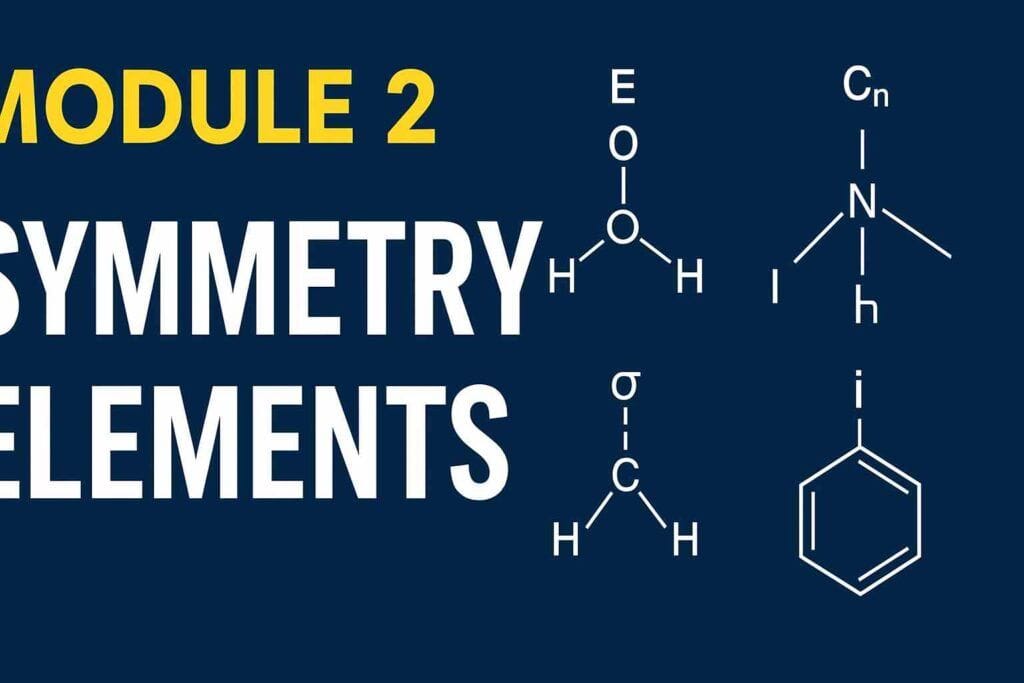
Chemistry में कुल 5 मुख्य symmetry elements होते हैं:
1️⃣ Identity (E)
2️⃣ Proper rotation axis (Cₙ)
3️⃣ Mirror planes (σ)
4️⃣ Centre of inversion (i)
5️⃣ Improper rotation axis (Sₙ)
अब इन पाँचों को विस्तार से समझते हैं:
1. Identity (E)
Identity क्या है?
यह सबसे सरल symmetry element है। इसमें molecule पर कुछ भी नहीं किया जाता, फिर भी वह “समान” ही दिखाई देता है।
👉 Identity हर molecule में हमेशा होता है।
यह कभी अनुपस्थित नहीं होता।
E क्यों आवश्यक है?
Group theory में किसी भी symmetry group का सबसे महत्वपूर्ण element Identity होता है। इसके बिना कोई भी group पूरा नहीं हो सकता।
Example:
H₂O, NH₃, BF₃, CH₄ सभी में E मौजूद है।
→ चाहे आप molecule को न घुमाएँ, न उलटें, फिर भी वह same है — यही Identity है।
2. Proper Rotation Axis (Cₙ)
यह symmetry तब होती है जब किसी molecule को एक axis के चारों ओर 360°/n घुमाने पर molecule बिल्कुल पहले जैसा दिखाई दे।
Cn का मतलब क्या?
- C₂ → 180° घुमाओ
- C₃ → 120° घुमाओ
- C₄ → 90° घुमाओ
- C₆ → 60° घुमाओ
Molecule में Highest order axis को principal axis कहते हैं।
✔ Examples of Cₙ:
(a) H₂O (Water)
- इसे 180° घुमाने पर वही shape → C₂ axis present
- यही इसका principal axis है।
(b) NH₃ (Ammonia)
- 120° rotation पर structure same
→ C₃ axis present
(c) BF₃ (Boron trifluoride)
- Trigonal planar → 120° rotation
→ C₃ axis present
(d) C₂H₄ (Ethene)
- 180° rotation → same
→ C₂ axis
3. Mirror Planes (σ)
Mirror plane (दर्पण समतल) वह plane होता है जो molecule को दो mirror image हिस्सों में बाँटता है।
Mirror planes के तीन प्रकार होते हैं:
(A) Vertical mirror plane (σv)
यह plane principal axis के parallel होता है।
Examples:
✔ NH₃ → 3 σv
✔ H₂O → 1 σv (plane passing through H–O–H)
(B) Horizontal mirror plane (σh)
यह plane principal axis के perpendicular होता है।
Examples:
✔ BF₃ (Trigonal planar) → 1 σh
✔ Square planar complexes जैसे [Ni(CN)₄]²⁻ → σh present
(C) Dihedral mirror plane (σd)
यह vertical plane है, लेकिन axis को bisect करते हुए गुजरता है।
यानी atoms के बीच से गुजरता है।
Examples:
✔ CH₄ → 6 σd
✔ C₂H₄ → σd present
4. Centre of Inversion (i)
यदि molecule में एक ऐसा central point हो जहाँ से किसी atom के सीधे opposite direction में same atom equal distance पर मौजूद हो → तो molecule में inversion center होता है।
Inversion का rule
Atom at position (x, y, z) → after inversion → becomes (–x, –y, –z)
✔ Examples of inversion (i):
(a) Benzene (C₆H₆)
Centre से opposite carbons एक-दूसरे के समान हैं
→ इसलिए benzene has i
(b) [Ni(CN)₄]²⁻ (square planar)
N opposite N, C opposite C
→ perfect inversion symmetry
(c) Octahedral complexes (ML₆ type)
→ सभी में inversion center होता है (except distorted ones)
❌ Note:
H₂O, NH₃, CH₄, BF₃ में inversion center नहीं होता।
5. Improper Rotation Axis (Sₙ)
यह सबसे complex symmetry element है।
इसमें दो step होते हैं:
Step 1: Rotate molecule by 360°/n
Step 2: उसके बाद σh plane में reflect करना
यदि यह combined operation molecule को same बना दे → Sₙ मौजूद है।
✔ Important Points
- जहाँ σh होता है, वहाँ हमेशा Sₙ मौजूद होता है।
- Many molecules with high symmetry have Sₙ (even if Cₙ is not enough).
✔ Examples:
(a) CH₄ (Methane)
S₄ axis present (but no C₄)
(b) BF₃
S₃ axis present (because σh exists)
(c) Benzene
Has S₆ (because C₆ + σh)
Summary: (One-line Revision)
| Element | Symbol | Meaning |
| Identity | E | No change |
| Proper Axis | Cₙ | Rotate by 360°/n |
| Mirror Planes | σ | Reflect symmetrically |
| Inversion Center | i | Atom → (–x, –y, –z) |
| Improper Axis | Sₙ | Rotate + Reflect |
- 1. Symmetry elements क्या होते हैं?
वे ज्यामितीय आधार (बिंदु, रेखा, समतल) जिनके about symmetry operations किए जाते हैं, symmetry elements कहलाते हैं। - 2. Identity element (E) क्या है?
जब molecule पर कोई परिवर्तन करने की आवश्यकता न हो और वह वैसा ही दिखे, उसे E कहा जाता है। - 3. Identity (E) हमेशा मौजूद क्यों होता है?
क्योंकि हर molecule बिना किसी परिवर्तन के अपने आप में समान दिखता है। - 4. Proper rotation axis (Cₙ) क्या होता है?
वह अक्ष जिसके चारों ओर 360°/n घुमाने पर molecule फिर से वही दिखाई दे। - 5. C₂ और C₃ में क्या अंतर है?
C₂ में 180° rotation से समान रूप मिलता है, जबकि C₃ में 120° rotation से। - 6. Mirror plane (σ) किसे कहते हैं?
एक ऐसा plane जो molecule को दो समान mirror images में बाँट दे। - 7. σv क्या होता है?
Vertical mirror plane जो principal axis के समानांतर होता है। - 8. σh किसे कहते हैं?
Horizontal mirror plane, जो principal axis के perpendicular होता है। - 9. σd क्या होता है?
Diagonal mirror plane जो molecule के bonds या angles के बीच से गुजरता है। - 10. Centre of inversion (i) क्या है?
एक central point जहाँ से किसी atom का opposite direction में समान atom equal दूरी पर मिले। - 11. Inversion operation में क्या किया जाता है?
हर atom को inversion center के opposite equal दूरी पर ले जाया जाता है। - 12. Improper rotation axis (Sₙ) क्या होता है?
पहले 360°/n rotation और फिर mirror reflection करने पर molecule वही दिखे तो Sₙ होता है। - 13. कौन-से molecules में inversion center पाया जाता है?
Benzene, C₂H₂, [Co(NH₃)₆]³⁺ जैसे highly symmetrical molecules में। - 14. CH₄ में कौन-से symmetry elements होते हैं?
C₃ axis, C₂ axes, और कई σd planes होते हैं, inversion नहीं होता। - 15. Symmetry elements जानना क्यों आवश्यक है?
क्योंकि इससे molecule की shape, polarity, spectroscopy और point group निर्धारित होते हैं।