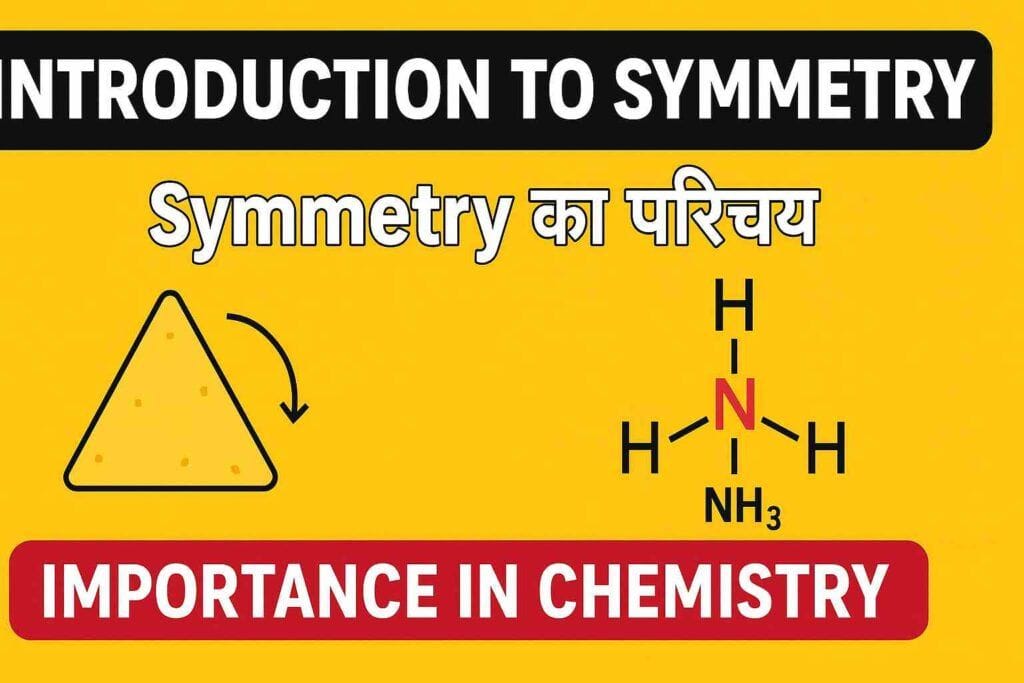
किसी वस्तु या अणु (molecule) में Symmetry तब होती है जब उस पर कुछ विशेष क्रियाएँ (operations) करने पर भी उसकी shape और दिखावट पहले जैसी ही दिखाई दे। सीधी भाषा में — Symmetry = बदले बिना बदलना
Audio Form Me sunne Ke liye Yaha Niche Click Kare|
रसायन विज्ञान (Chemistry) में Symmetry क्यों ज़रूरी है?
Symmetry की मदद से हम —
मॉलिक्यूल की shape समझते हैं
VSEPR theory के बाद symmetry बताती है कि shape कैसे बनी है।
स्पेक्ट्रा (IR, Raman) की भविष्यवाणी करते हैं
कौन–सा bond IR में active होगा, कौन सा Raman में। Orbitals की मिश्रण (Hybridization) समझते हैं
Symmetry elements से ही group theory molecular orbitals तैयार करती है।
Chemical properties और polarity समझते हैं
Symmetrical molecules अक्सर non-polar होते हैं (जैसे CO₂)।
Complexes की geometry पहचानते हैं
जैसे square planar, tetrahedral, octahedral etc.
इसलिए symmetry chemistry की लगभग हर शाखा में काम आती है — spectroscopy, bonding, reactions, stereochemistry, crystallography, सबमें।
Symmetry की मूल बातें (Basics) आसान उदाहरणों के साथ
हम symmetry को समझने के लिए दो शब्द सीखते हैं:
(A) Symmetry Element
वह “चीज़” जिसके बारे में हम कोई operation कर सकते हैं। जैसे एक line, point, plane।
(B) Symmetry Operation
वह “क्रिया” जो हम symmetry element के बारे में करते हैं। जैसे — घुमाना, पलटना, उलटना, आदि।
मुख्य Symmetry Elements और आसान उदाहरण
Axis of Symmetry (Cₙ) — घुमाव वाली symmetry
यदि आप किसी वस्तु/मॉलिक्यूल को एक लाइन (axis) के about 360°/n घुमाते हैं और वह पहले जैसा ही दिखे — तो उसे Cₙ axis कहते हैं।
उदाहरण: समोसा (triangular shape)
समोसा को 120° घुमाओ → shape वैसी ही। इसमें C₃ symmetry axis है।
NH₃ (Ammonia)
इसको 120° घुमाने पर shape पहले जैसी ही रहती है। इसमें C₃ axis मौजूद है।
Plane of Symmetry (σ) — दर्पण जैसी symmetry
यदि कोई molecule दो हिस्सों में ऐसे बँट जाए कि एक हिस्सा दूसरे का mirror image हो — तो plane of symmetry होता है।
उदाहरण:
H₂O (Water) O के बीच से एक plane जाकर H–H को mirror बनाता है। → इसलिए H₂O में एक σ_v plane है।
मानव चेहरा (face) हमारा चेहरा लगभग एक mirror plane रखता है।
Center of Symmetry (i) — inversion center
यदि molecule के किसी point से opposite directions में equal distance पर समान तत्व हों → center of symmetry होता है।
उदाहरण:
Benzene (C₆H₆) center से opposite carbon और hydrogen pair equal दूरी पर हैं। Benzene में center of inversion (i) है।
[Ni(CN)₄]²⁻ (square planar) इस complex में perfect inversion symmetry होती है।
Improper Axis of Rotation (Sₙ)
यह दो operations का combination है: पहले 360°/n घुमाना फिर plane में reflect करना
उदाहरण:
CH₄ (Methane) इसमें S₄ axis होती है।
BF₃ (boron trifluoride) इसमें S₃ usual होता है।
बहुत सरल उदाहरणों से समझो (Daily life examples) तितली (butterfly)
इसके पंख mirror image होते हैं → plane of symmetry।
✔ पंखा (ceiling fan)
120° घुमाओ → पहले जैसा दिखता है → C₃ axis।
✔ समतल कागज पर drawn फूल
कई petals → multiple symmetry axes।
✔ चॉकलेट का square piece
4-fold rotational symmetry → C₄ axis।
समापन (Conclusion)
Chemistry में symmetry molecules की hidden structure को समझने का आसान तरीका है। इससे — 👉 shape 👉 polarity 👉 spectral activity 👉 bonding सबकुछ आसानी से predict किया जाता है।
FAQ
1. Symmetry क्या होती है? Symmetry वह गुण है जिसमें molecule पर कुछ परिवर्तन करने पर भी उसकी shape वैसी की वैसी रहती है।
2. Chemistry में symmetry क्यों महत्वपूर्ण है? Symmetry से molecule की shape, polarity, spectra (IR, Raman), bonding और orbital interactions समझ में आते हैं।
3. Symmetry element किसे कहते हैं? वह बिंदु, रेखा या समतल जिसके about symmetry operation होता है, symmetry element कहलाता है।
4. Symmetry operation क्या होता है? मolecule पर किया गया वह कार्य जिससे transformation के बाद molecule पहले जैसा दिखे।
5. Identity operation (E) क्या होता है? जब molecule में कोई भी परिवर्तन नहीं किया जाता और वह वैसा ही रहता है, उसे identity कहते हैं।
6. Proper rotation axis क्या है? जब molecule को किसी axis के चारों ओर 360°/n घुमाने पर वही रूप मिले, तो इसे Cₙ axis कहते हैं।
7. Mirror plane (σ) क्या होता है? एक ऐसा plane जो molecule को दो mirror-image हिस्सों में बाँट दे, mirror plane कहलाता है।
8. Centre of inversion (i) क्या है? एक central point जहाँ से opposite दिशाओं में समान atoms equal दूरी पर हों।
9. Improper rotation axis (Sₙ) क्या होता है? पहले 360°/n rotation और फिर reflection करने पर अगर molecule same मिले, तो Sₙ मौजूद होता है।
10. Principal axis किसे कहते हैं? Molecule में मौजूद सबसे बड़ा (highest order) Cₙ axis को principal axis कहते हैं।
11. NH₃ में कौन-सी symmetry मौजूद है? NH₃ में C₃ axis और 3 σv plane मौजूद होते हैं।
12. H₂O में कौन-सी symmetry होती है? H₂O में C₂ axis और 1 σv plane होता है।
13. Benzene में कौन-सा विशेष symmetry element होता है? Benzene में inversion center (i) और S₆ axis मौजूद होता है।
14. Symmetrical molecules ज़्यादातर non-polar क्यों होते हैं? क्योंकि उनके dipole moments आपस में cancel हो जाते हैं।
15. Daily life में symmetry कहाँ दिखाई देती है? तितली, पंखा, फूलों की पंखुड़ियाँ, मानव चेहरा, और geometrical designs में symmetry आम होती है।