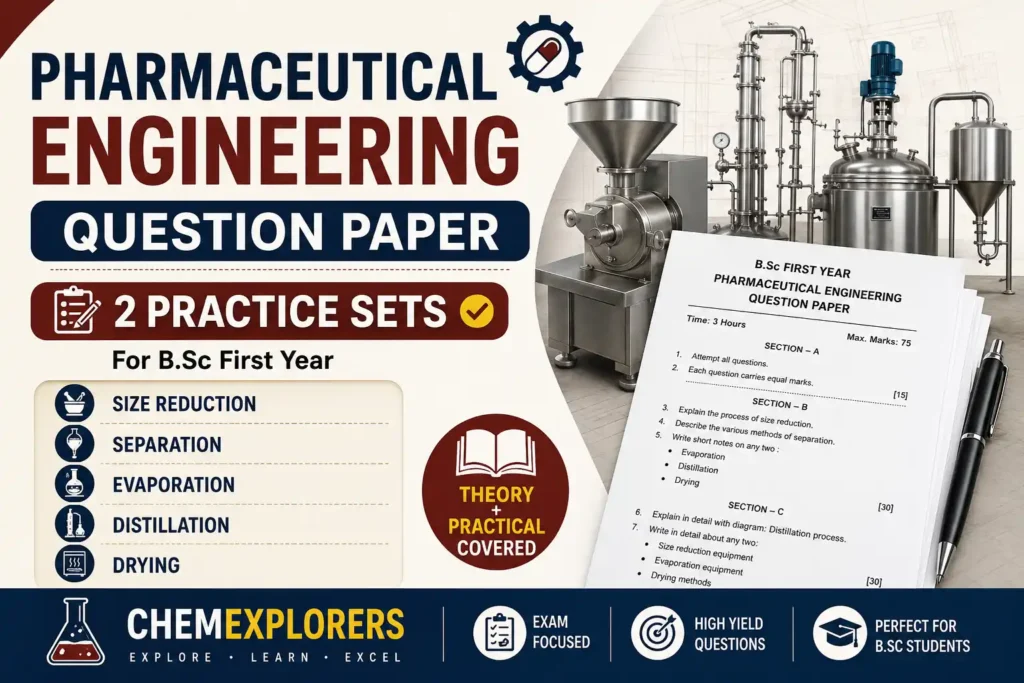
Pharmaceutical Engineering Question Paper
Pharmaceutical Engineering Question Paper : 2 practice sets for B.Sc First Year covering size reduction, separation, evaporation, distillation and drying.
Roll No. ………………………
SEC-107
मॉडल प्रश्न पत्र – सेट 1
MODEL PAPER — SET 1
प्रमाणपत्र / बी.एस-सी. (प्रथम वर्ष) (NEP) परीक्षा, 2026
Certificate / B.Sc. (First Year) (NEP) Examination, 2026
फार्मास्युटिकल विनिर्माण एवं गुणवत्ता
Pharmaceutical Manufacturing and Quality
स्किल एनहांसमेंट कोर्स – I : फार्मास्युटिकल इंजीनियरिंग – I
Skill Enhancement Course – I : Pharmaceutical Engineering – I
(आधारित : Unit I – IV, सम्पूर्ण पाठ्यक्रम) / (Based on Unit I – IV, Full Syllabus)
नोट : सभी तीनों खण्डों से निर्देशानुसार प्रश्नों के उत्तर दीजिए। अंकों का वितरण खण्डों के साथ दिया गया है।
Note: Attempt questions of all the three Sections as directed. Distribution of marks is given with the Sections.
(अति लघु उत्तरीय प्रश्न) (प्रत्येक 50 शब्दों में) — 2×5=10
(Very Short Answer Type Questions) (50 words each) — 2×5=10
नोट : किन्हीं पाँच प्रश्नों के उत्तर दीजिए। सभी प्रश्नों के अंक समान हैं।
Note: Attempt any five questions. All questions carry equal marks.
साइज़ रिडक्शन (size reduction) को परिभाषित कीजिए।
Define size reduction.
सीव (sieve) क्या है?
What is a sieve?
एवैपोरेशन (evaporation) को परिभाषित कीजिए।
Define evaporation.
फ्रैक्शनल डिस्टिलेशन (fractional distillation) क्या है?
What is fractional distillation?
इक्विलिब्रियम मॉइस्चर कंटेंट (equilibrium moisture content) क्या है?
What is equilibrium moisture content?
फ्लुइडाइज़्ड बेड ड्रायर (fluidized bed dryer) को परिभाषित कीजिए।
Define fluidized bed dryer.
(लघु उत्तरीय प्रश्न) (प्रत्येक 200 शब्दों में) — 5×8=40
(Short Answer Type Questions) (200 words each) — 5×8=40
नोट : किन्हीं पाँच प्रश्नों के उत्तर दीजिए। सभी प्रश्नों के अंक समान हैं।
Note: Attempt any five questions. All questions carry equal marks.
बॉल मिल (ball mill) के प्रिंसिपल, कंस्ट्रक्शन एवं वर्किंग को समझाइए।
Explain the principle, construction, and working of a ball mill.
साइक्लोन सेपरेटर (cyclone separator) के उपयोग एवं मेरिट्स/डीमेरिट्स का वर्णन कीजिए।
Describe the uses and merits/demerits of a cyclone separator.
साइज़ रिडक्शन को प्रभावित करने वाले कारकों (factors) को समझाइए।
Explain the factors affecting size reduction.
स्टीम जैकेटेड केटल (steam jacketed kettle) के कंस्ट्रक्शन एवं वर्किंग को समझाइए।
Explain the construction and working of a steam jacketed kettle.
सिंपल डिस्टिलेशन एवं फ्रैक्शनल डिस्टिलेशन में अंतर समझाइए।
Explain the difference between simple distillation and fractional distillation.
ट्रे ड्रायर (tray dryer) के प्रिंसिपल, कंस्ट्रक्शन एवं वर्किंग का वर्णन कीजिए।
Describe the principle, construction, and working of a tray dryer.
पाउडर्स एवं सीव्स के ऑफिशियल स्टैंडर्ड्स को समझाइए।
Explain the official standards of powders and sieves.
(दीर्घ उत्तरीय प्रश्न) (प्रत्येक 500 शब्दों में) — 2×25=50
(Long Answer Type Questions) (500 words each) — 2×25=50
नोट : किन्हीं दो प्रश्नों के उत्तर दीजिए। सभी प्रश्नों के अंक समान हैं।
Note: Attempt any two questions. All questions carry equal marks.
-
(अ)हैमर मिल एवं बॉल मिल के प्रिंसिपल, कंस्ट्रक्शन, वर्किंग, उपयोग तथा उनके मेरिट्स/डीमेरिट्स की विस्तृत तुलनात्मक व्याख्या कीजिए।
(a) Give a detailed comparative explanation of the principle, construction, working, uses, and merits/demerits of a hammer mill and a ball mill.
(ब)साइज़ रिडक्शन के मैकेनिज़्म्स एवं नियमों (जैसे रिटिंगर लॉ, किक लॉ) को समझाइए।(b) Explain the mechanisms and laws of size reduction (such as Rittinger’s law and Kick’s law).
साइज़ सेपरेशन की ऑब्जेक्टिव्स, एप्लीकेशंस एवं मैकेनिज़्म की विस्तृत विवेचना कीजिए, सीव शेकर एवं साइक्लोन सेपरेटर के संदर्भ में।
Discuss in detail the objectives, applications, and mechanism of size separation with reference to sieve shaker and cyclone separator.
एवैपोरेशन एवं डिस्टिलेशन के प्रमुख प्रकारों (स्टीम जैकेटेड केटल, हॉरिज़ॉन्टल ट्यूब एवैपोरेटर, फ्रैक्शनल डिस्टिलेशन, मॉलिक्यूलर डिस्टिलेशन) का विस्तृत वर्णन कीजिए।
Discuss in detail the major types of evaporation and distillation (steam jacketed kettle, horizontal tube evaporator, fractional distillation, molecular distillation).
ड्राइंग प्रोसेस की ऑब्जेक्टिव्स, मैकेनिज़्म, इक्विलिब्रियम मॉइस्चर कंटेंट एवं रेट ऑफ ड्राइंग कर्व की व्याख्या कीजिए, ट्रे ड्रायर, स्प्रे ड्रायर एवं फ्लुइडाइज़्ड बेड ड्रायर के संदर्भ में।
Explain the objectives, mechanism, equilibrium moisture content, and rate of drying curve of the drying process, with reference to tray dryer, spray dryer, and fluidized bed dryer.
✦ ✦ ✦ ✦ ✦ ✦ ✦ ✦
Roll No. ………………………
SEC-107
मॉडल प्रश्न पत्र – सेट 2
MODEL PAPER — SET 2
प्रमाणपत्र / बी.एस-सी. (प्रथम वर्ष) (NEP) परीक्षा, 2026
Certificate / B.Sc. (First Year) (NEP) Examination, 2026
फार्मास्युटिकल विनिर्माण एवं गुणवत्ता
Pharmaceutical Manufacturing and Quality
स्किल एनहांसमेंट कोर्स – I : फार्मास्युटिकल इंजीनियरिंग – I
Skill Enhancement Course – I : Pharmaceutical Engineering – I
(आधारित : Unit I – IV, सम्पूर्ण पाठ्यक्रम) / (Based on Unit I – IV, Full Syllabus)
नोट : सभी तीनों खण्डों से निर्देशानुसार प्रश्नों के उत्तर दीजिए। अंकों का वितरण खण्डों के साथ दिया गया है।
Note: Attempt questions of all the three Sections as directed. Distribution of marks is given with the Sections.
(अति लघु उत्तरीय प्रश्न) (प्रत्येक 50 शब्दों में) — 2×5=10
(Very Short Answer Type Questions) (50 words each) — 2×5=10
नोट : किन्हीं पाँच प्रश्नों के उत्तर दीजिए। सभी प्रश्नों के अंक समान हैं।
Note: Attempt any five questions. All questions carry equal marks.
बॉल मिल (ball mill) को परिभाषित कीजिए।
Define ball mill.
साइक्लोन सेपरेटर (cyclone separator) क्या है?
What is a cyclone separator?
स्टीम डिस्टिलेशन (steam distillation) क्या है?
What is steam distillation?
रेट ऑफ ड्राइंग कर्व (rate of drying curve) क्या है?
What is the rate of drying curve?
स्प्रे ड्रायर (spray dryer) को परिभाषित कीजिए।
Define spray dryer.
मॉलिक्यूलर डिस्टिलेशन (molecular distillation) क्या है?
What is molecular distillation?
(लघु उत्तरीय प्रश्न) (प्रत्येक 200 शब्दों में) — 5×8=40
(Short Answer Type Questions) (200 words each) — 5×8=40
नोट : किन्हीं पाँच प्रश्नों के उत्तर दीजिए। सभी प्रश्नों के अंक समान हैं।
Note: Attempt any five questions. All questions carry equal marks.
हैमर मिल (hammer mill) के उपयोग एवं मेरिट्स/डीमेरिट्स का वर्णन कीजिए।
Describe the uses and merits/demerits of a hammer mill.
सीव शेकर (sieve shaker) के प्रिंसिपल एवं वर्किंग को समझाइए।
Explain the principle and working of a sieve shaker.
एवैपोरेशन एवं अन्य हीट प्रोसेसेज़ के बीच अंतर को समझाइए।
Explain the difference between evaporation and other heat processes.
हॉरिज़ॉन्टल ट्यूब एवैपोरेटर (horizontal tube evaporator) के कंस्ट्रक्शन एवं वर्किंग का वर्णन कीजिए।
Describe the construction and working of a horizontal tube evaporator.
डिस्टिलेशन अंडर रिड्यूस्ड प्रेशर एवं फ्लैश डिस्टिलेशन को समझाइए।
Explain distillation under reduced pressure and flash distillation.
स्प्रे ड्रायर एवं फ्लुइडाइज़्ड बेड ड्रायर के उपयोग एवं मेरिट्स/डीमेरिट्स का वर्णन कीजिए।
Describe the uses and merits/demerits of a spray dryer and a fluidized bed dryer.
ड्राइंग प्रोसेस की मैकेनिज़्म एवं एप्लीकेशंस को समझाइए।
Explain the mechanism and applications of the drying process.
(दीर्घ उत्तरीय प्रश्न) (प्रत्येक 500 शब्दों में) — 2×25=50
(Long Answer Type Questions) (500 words each) — 2×25=50
नोट : किन्हीं दो प्रश्नों के उत्तर दीजिए। सभी प्रश्नों के अंक समान हैं।
Note: Attempt any two questions. All questions carry equal marks.
-
(अ)साइज़ सेपरेशन की ऑब्जेक्टिव्स, एप्लीकेशंस एवं मैकेनिज़्म की विस्तृत व्याख्या कीजिए।
(a) Explain in detail the objectives, applications, and mechanism of size separation.
(ब)सीव शेकर एवं साइक्लोन सेपरेटर के प्रिंसिपल, कंस्ट्रक्शन, वर्किंग तथा उनके मेरिट्स/डीमेरिट्स की तुलनात्मक विवेचना कीजिए।(b) Give a comparative discussion of the principle, construction, working, and merits/demerits of a sieve shaker and a cyclone separator.
साइज़ रिडक्शन की ऑब्जेक्टिव्स, मैकेनिज़्म्स एवं नियमों की विस्तृत विवेचना कीजिए, हैमर मिल एवं बॉल मिल के संदर्भ में।
Discuss in detail the objectives, mechanisms, and laws of size reduction with reference to hammer mill and ball mill.
एवैपोरेशन को प्रभावित करने वाले कारकों एवं डिस्टिलेशन की मूल सिद्धांतों तथा विधियों का विस्तृत वर्णन कीजिए।
Discuss in detail the factors influencing evaporation and the basic principles and methodology of distillation.
ट्रे ड्रायर, स्प्रे ड्रायर एवं फ्लुइडाइज़्ड बेड ड्रायर के प्रिंसिपल, कंस्ट्रक्शन, वर्किंग एवं उनके मेरिट्स/डीमेरिट्स की तुलनात्मक व्याख्या कीजिए।
Give a comparative explanation of the principle, construction, working, and merits/demerits of a tray dryer, spray dryer, and fluidized bed dryer.
✦ ✦ ✦ ✦ ✦ ✦ ✦ ✦
Sterile Manufacturing Pharma Model Question Paper (2 Sets)
MP GK Quiz Online Free | MPPSC Practice Questions Hindi
1. What is the Pharmaceutical Engineering Question Paper for B.Sc First Year?
The Pharmaceutical Engineering Question Paper is designed according to the B.Sc First Year syllabus and includes important topics such as size reduction, separation, evaporation, distillation, and drying. It helps students understand the exam pattern and improve their preparation with practice questions.
2. Why should students practice the Pharmaceutical Engineering Question Paper?
Practicing the Pharmaceutical Engineering Question Paper helps students revise key concepts, improve time management, identify important topics, and gain confidence before the examination. It is one of the best resources for scoring higher marks.
3. Which topics are covered in the Pharmaceutical Engineering Question Paper?
The Pharmaceutical Engineering Question Paper covers major topics including:
- Size Reduction
- Separation Techniques
- Evaporation
- Distillation
- Drying Equipment & Methods
- Numerical Problems and Short Notes based on the B.Sc First Year syllabus.
4. Does the Pharmaceutical Engineering Question Paper include model practice sets?
Yes. This Pharmaceutical Engineering Question Paper provides 2 practice sets prepared according to the latest B.Sc First Year pattern. These model papers help students practice expected exam questions and strengthen their conceptual understanding.
5. Where can I download the Pharmaceutical Engineering Question Paper PDF?
You can download the latest Pharmaceutical Engineering Question Paper PDF from ChemExplorers, where you’ll find free model question papers, previous year questions, important notes, and exam-oriented study material for B.Sc First Year students.