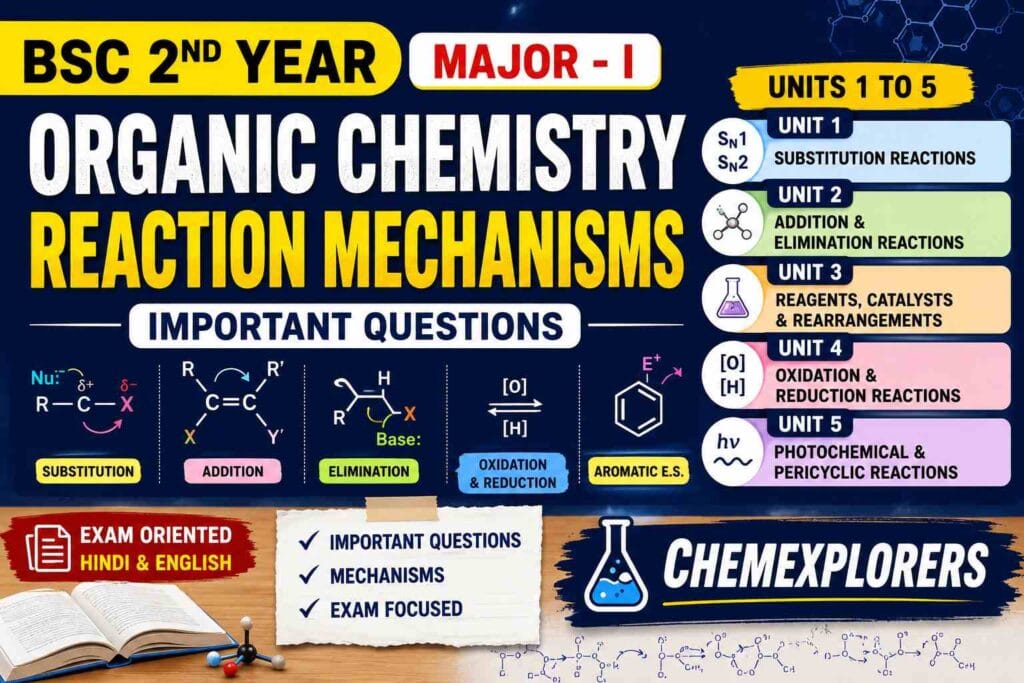
Organic Reaction Mechanisms Notes & Important Questions | Units 1–5 B.Sc Chemistry 2026
Download B.Sc Organic Chemistry important questions and notes for Units 1 to 5 including substitution, addition, elimination, oxidation, reduction, photochemical and pericyclic reactions. Exam-oriented Hindi and English questions with mechanisms for 2026 university exams.
Important Questions (Exam Oriented)
1. Explain SN1 and SN2 mechanisms with comparison.
हिंदी: SN1 और SN2 अभिक्रिया तंत्र को अंतर सहित समझाइए।
मुख्य बिंदु:
- Mechanism (तंत्र)
- Rate law (वेग नियम)
- Effect of substrate and nucleophile
- Stereochemistry
- Difference between SN1 and SN2
Relevant formula/concept:
Rate of SN1=k[RX],Rate of SN2=k[RX][Nu−]
2. Explain Aromatic Electrophilic Substitution and orientation effect.
हिंदी: Aromatic Electrophilic Substitution तथा orientation/directive effect को समझाइए।
मुख्य बिंदु:
- Arenium ion mechanism
- Ortho, para and meta directing groups
- Activating and deactivating groups
- Electronic explanation
- Examples: nitration, halogenation
Important reaction concept:
Ar−H+E+→Ar−E+H+
Unit 2 – Important Exam Questions
1. Explain Markovnikov and Anti-Markovnikov addition reactions with examples.
हिंदी: मार्कोनिकोव तथा एंटी-मार्कोनिकोव योग अभिक्रियाओं को उदाहरण सहित समझाइए।
मुख्य बिंदु:
- Regioselectivity
- Orientation of addition
- Peroxide effect
- Mechanism with alkene reactions
Important concept:
CH2=CH2+HX→CH3−CH2X
2. Explain E1 and E2 elimination mechanisms with differences.
हिंदी: E1 तथा E2 elimination mechanism को अंतर सहित समझाइए।
मुख्य बिंदु:
- Mechanism
- Rate law
- Saytzeff rule
- Hofmann rule
- Effect of substrate and base
Rate expression:
Rate of E1=k[RX],Rate of E2=k[RX][Base]
Unit 3 – Important Exam Questions
1. Explain preparation, properties and applications of Grignard reagent.
हिंदी: ग्रिगनार्ड अभिकर्मक की तैयारी, गुण एवं उपयोगों को समझाइए।
मुख्य बिंदु:
- Preparation in dry ether
- Structure and reactivity
- Reaction with aldehydes/ketones
- Applications in organic synthesis
Important reaction:
RMgX+HCHO→RCH2OH
2. Explain Beckmann rearrangement or Baeyer–Villiger rearrangement with mechanism.
हिंदी: Beckmann rearrangement अथवा Baeyer–Villiger rearrangement को तंत्र सहित समझाइए।
मुख्य बिंदु:
- Rearrangement mechanism
- Migration of groups
- Formation of amide/lactone or ester
- Applications in synthesis
Important concept:
R−CO−R′+Peracid→Ester
Unit 4 – Important Exam Questions
1. Explain oxidation of alcohols to carbonyl compounds with suitable oxidizing agents.
हिंदी: अल्कोहॉल का कार्बोनिल यौगिकों में ऑक्सीकरण उपयुक्त ऑक्सीकारकों सहित समझाइए।
मुख्य बिंदु:
- Oxidation of primary and secondary alcohols
- Chromium and manganese reagents
- Formation of aldehydes and ketones
- Mechanism and applications
Important reaction:
RCH2OH+[O]→RCHO→RCOOH
2. Explain catalytic hydrogenation and reduction by LiAlH4 and NaBH4.
हिंदी: उत्प्रेरक हाइड्रोजनीकरण तथा LiAlH₄ एवं NaBH₄ द्वारा अपचयन को समझाइए।
मुख्य बिंदु:
- Catalytic hydrogenation
- Palladium/Raney Nickel catalyst
- Difference between LiAlH₄ and NaBH₄
- Reduction of aldehydes and ketones
- Mechanism and applications
Important reduction reaction:
RCHO+2[H]→RCH2OH
Unit 5 – Important Exam Questions
1. Explain Norrish Type I and Norrish Type II photochemical reactions.
हिंदी: Norrish Type I तथा Norrish Type II प्रकाश-रासायनिक अभिक्रियाओं को समझाइए।
मुख्य बिंदु:
- Photochemical excitation
- Free radical formation
- Cleavage reactions
- Mechanism and examples
- Difference between Type I and Type II
Photochemical concept:
R−CO−RhνFree Radical Products
2. Explain Claisen rearrangement and Cope rearrangement with mechanism.
हिंदी: Claisen rearrangement तथा Cope rearrangement को तंत्र सहित समझाइए।
मुख्य बिंदु:
- Pericyclic reactions
- Sigmatropic rearrangement
- Concerted mechanism
- Applications in organic synthesis
- Difference between Claisen and Cope rearrangement
Important rearrangement concept:
[3,3]-Sigmatropic Rearrangement