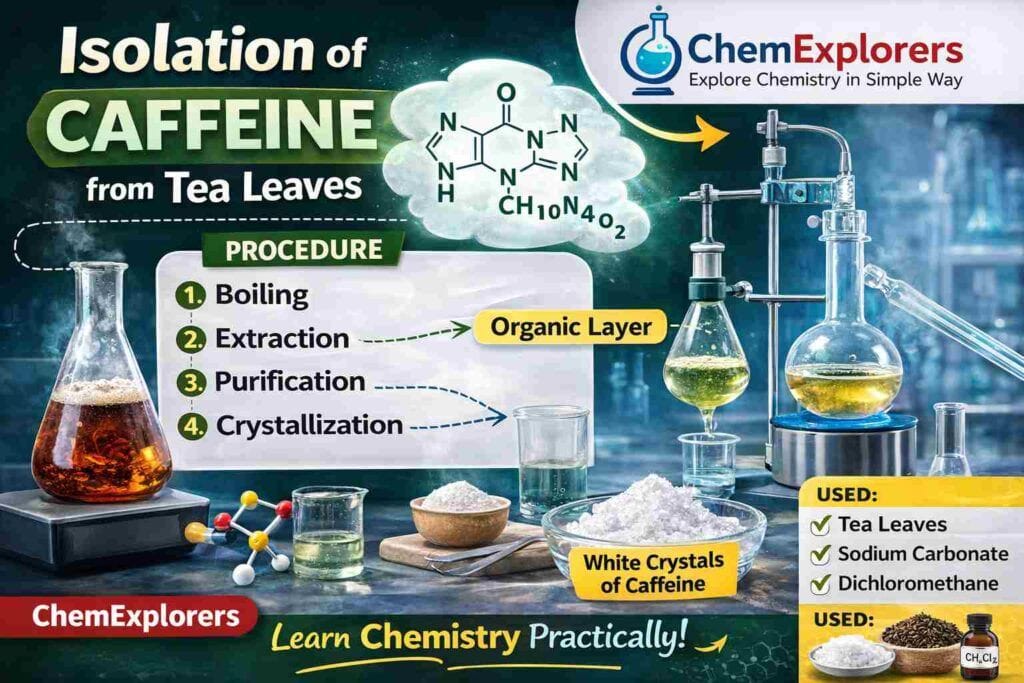
isolation of caffeine from tea leaves practical
Learn the isolation of caffeine from tea leaves through a simple organic chemistry practical. This experiment explains the extraction of caffeine using solvent extraction, including principle, procedure, chemicals used, and formation of caffeine crystals. Ideal for B.Sc. and M.Sc. chemistry students studying organic laboratory techniques.
Isolation of Caffeine from Tea Leaves
1. उद्देश्य (Aim)
Tea leaves से caffeine को अलग (isolate) करना तथा उसके गुणों का अध्ययन करना।
2. सिद्धांत (Principle)
चाय की पत्तियों में caffeine (C₈H₁₀N₄O₂) एक alkaloid होता है।
Tea leaves में caffeine के साथ tannins, pigments और अन्य organic compounds भी होते हैं।
Caffeine को अलग करने के लिए सामान्यतः solvent extraction method का उपयोग किया जाता है।
- Tea leaves को पानी में उबालकर caffeine solution बनाया जाता है।
- Sodium carbonate (Na₂CO₃) मिलाने से tannins neutral हो जाते हैं।
- इसके बाद organic solvent (chloroform या dichloromethane) से extraction किया जाता है।
- Organic layer से solvent को evaporate करने पर caffeine के crystals प्राप्त होते हैं।
3. रासायनिक सूत्र (Chemical Formula)
Caffeine
C₈H₁₀N₄O₂
4. आवश्यक उपकरण (Apparatus)
- Beaker
- Conical flask
- Separating funnel
- Water bath
- Funnel
- Filter paper
- Glass rod
- Evaporating dish
5. आवश्यक रसायन (Chemicals)
- Tea leaves
- Sodium carbonate (Na₂CO₃)
- Dichloromethane / Chloroform
- Distilled water
6. प्रयोग विधि (Procedure)
Step 1 – Extraction
- लगभग 10 g tea leaves को beaker में लें।
- इसमें 100 mL distilled water मिलाएँ।
- Solution को 10–15 मिनट तक उबालें ताकि caffeine पानी में घुल जाए।
Step 2 – Filtration
- Solution को filter paper से छान लें।
- Filtrate में caffeine और अन्य soluble compounds मौजूद रहते हैं।
Step 3 – Addition of Sodium Carbonate
- Filtrate में थोड़ा sodium carbonate मिलाएँ।
- इससे tannins neutral हो जाते हैं।
Step 4 – Solvent Extraction
- Solution को separating funnel में डालें।
- इसमें 20–25 mL dichloromethane / chloroform मिलाएँ।
- Separating funnel को अच्छी तरह हिलाएँ।
अब दो layers बनेंगी:
- Upper layer – aqueous layer
- Lower layer – organic layer (caffeine)
Step 5 – Separation
- Lower organic layer को अलग कर लें।
Step 6 – Evaporation
- Organic solvent को water bath पर evaporate करें।
Step 7 – Crystallization
- Evaporation के बाद white crystals of caffeine प्राप्त होते हैं।
7. प्रेक्षण (Observation)
| Observation | Result |
|---|---|
| Tea solution color | Brown |
| Organic layer | Colorless |
| Final product | White crystals |
8. परिणाम (Result)
इस प्रयोग में tea leaves से caffeine को सफलतापूर्वक isolate किया गया तथा यह white crystalline solid के रूप में प्राप्त हुआ।
9. सावधानियाँ (Precautions)
- Separating funnel को हिलाते समय venting करें।
- Organic solvent का प्रयोग fume hood में करें।
- Extraction के समय layers को सही पहचानें।
- Solvent को पूरी तरह evaporate करें।
10. Viva Questions (Exam में पूछे जाते हैं)
Q1. Caffeine क्या है?
Ans. Caffeine एक alkaloid compound है जो tea और coffee में पाया जाता है।
Q2. Sodium carbonate क्यों मिलाते हैं?
Ans. Tannins को neutral करने के लिए।
Q3. Extraction में कौन-सा solvent उपयोग होता है?
Ans. Dichloromethane या chloroform।
Q4. Caffeine का रंग क्या होता है?
Ans. White crystalline solid।