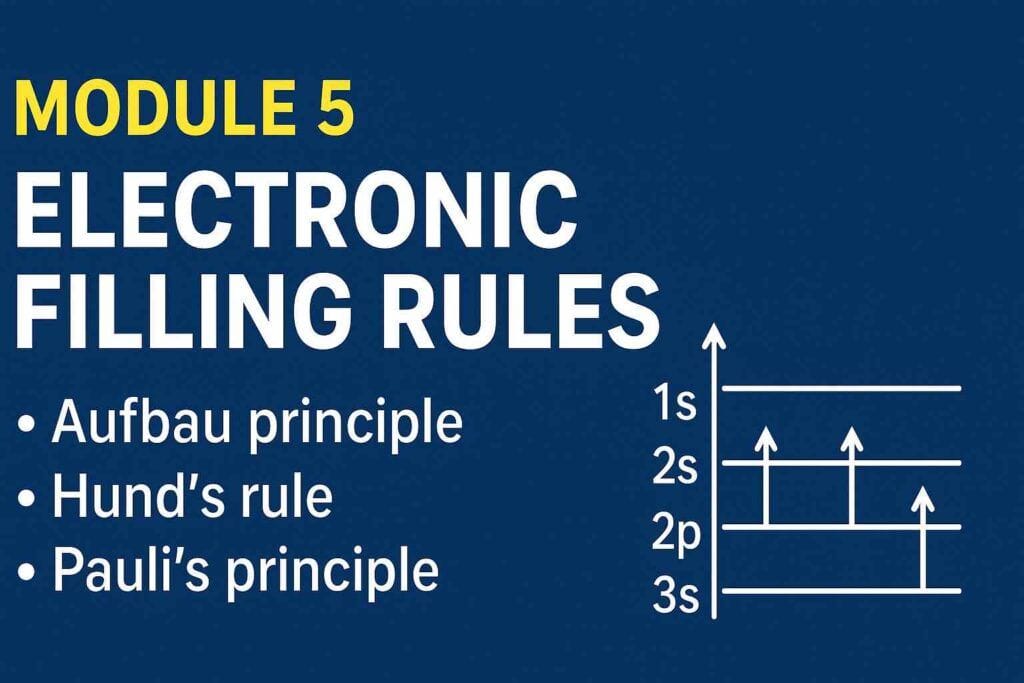
BSc 1 Year Chemistry Major 1 Unit 2 Module 5
MODULE 5 – Electronic Filling Rules
Aufbau Principle | Hund’s Rule | Pauli’s Principle | Orbital Energy Order | 3d vs 4s
INTRO
“नमस्कार विद्यार्थियों!
आज हम Module 5 — Electronic Filling Rules — को समझेंगे।
यही चार नियम मिलकर यह बताते हैं कि इलेक्ट्रॉन किसी भी परमाणु में किस क्रम में भरेंगे।
इन नियमों को समझे बिना आप कभी भी electronic configuration सही नहीं लिख पाएँगे।
तो आइए, इसे सबसे आसान भाषा में step-by-step सीखते हैं।”
iska audio suunne ke liye niche click kare
PART 1 — Aufbau Principle (और इसकी सीमाएँ)
Definition (परिभाषा)
Aufbau principle कहता है कि
“इलेक्ट्रॉन हमेशा सबसे कम ऊर्जा वाले orbital में पहले भरते हैं, और धीरे-धीरे उच्च ऊर्जा वाले orbital की ओर जाते हैं।”
इसे n + l rule से समझते हैं:
- जिस orbital का n + l मान कम, उसकी energy कम
- पहले वही orbital भरेगा
- यदि n + l बराबर हो, तो जिसका n कम हो, उसकी energy कम मानी जाती है|
- Aufbau का अर्थ
- “Aufbau” जर्मन शब्द है, जिसका अर्थ है — ‘To build up’ (एक-एक करके बनाना)
यह सिद्धान्त कहता है:
➡ Electrons सबसे कम ऊर्जा वाले orbital से भरना शुरू करते हैं। - इसका मतलब — energy order तय करेगा कि electron पहले कहाँ जाएगा।
- Energy Order याद रखने का तरीका — (n + l) Rule
- Orbital energy = n + l
✔ जिसका (n + l) कम → energy कम
✔ अगर दो orbitals का (n + l) बराबर → फिर n छोटा हो तो energy कम - उदाहरण 1:
- 4s : n+l = 4+0 = 4
3d : n+l = 3+2 = 5
👉 इसलिए 4s की energy 3d से कम होती है
इसीलिए electrons पहले 4s में और फिर 3d में जाते हैं।
Example 1
Which fills first: 4s or 3d?
- 4s → n = 4, l = 0 → n+l = 4
- 3d → n = 3, l = 2 → n+l = 5
→ 4s का n+l कम है, इसलिए electron पहले 4s में भरता है।
Example 2
Which fills first: 3p or 4s?
- 3p → n = 3, l = 1 → n+l = 4
- 4s → n = 4, l = 0 → n+l = 4
अब दोनों में n+l बराबर = 4
→ n जिसकी कम (3p), वह पहले भरेगा।
Aufbau की सीमाएँ (Limitations)
- Transition metals में order उलट जाता है
– जैसे Fe, Cu, Cr, Ni में sometimes 3d की energy 4s के बराबर या कम हो जाती है
– इसलिए ionization में electron पहले 4s से निकल जाता है। - Energy के gaps बहुत छोटे होते हैं
– इसलिए बहुत से atoms में anomalies मिलती हैं। - आप orbital energies को fixed numbers न मानें
– यह atom to atom बदलती रहती है। - Transition metals में actual energy order बदल जाता है
- Excited states में Aufbau principle लागू नहीं
- कुछ atoms anomalous configuration बनाते हैं (जैसे Cr, Cu)
PART 2 — Pauli’s Exclusion Principle
Definition
Pauli principle कहता है:
“एक atom में कोई दो electrons चारों quantum numbers (n, l, mₗ, mₛ) समान नहीं रख सकते।”
एक orbital में:
- अधिकतम 2 electrons
- और उनके spin opposite होंगे
(↑↓)
Example 1: Helium (1s²)
दोनों electrons = same orbital (1s)
→ spin opposite होंगे: ↑↓
Example 2: If you try to put 3 electrons in 1s
Impossible!
क्योंकि 1 orbital केवल 2 electrons को opposite spin के साथ रख सकता है।
Pauli ने कहा:
➡ एक orbital में अधिकतम दो electrons आ सकते हैं
और
➡ उनके spin अवश्य opposite होंगे (+½ और −½)
इसके बिना atom collapse हो जाता
अगर spin opposite न हो, तो electrons एक ही orbital में repulsion से रुक नहीं सकते।
✔ Example
1s orbital → अधिकतम 2 electrons
→ 1s² configuration Pauli principle से ही संभव है।
PART 3 — Hund’s Rule of Maximum Multiplicity
Definition
Hund’s Rule कहता है:
“जब एक ही energy वाले कई orbitals हों (degenerate orbitals), तो इलेक्ट्रॉन पहले हर orbital में अकेले-अकेले समान spin के साथ भरते हैं। Pairing बाद में होती है।”
इसका कारण—
Electrons repulsion कम करने की कोशिश करते हैं → इसलिए वे orbitals में फैल जाते हैं।
Hund’s rule कहता है:
➡ जब एक subshell में कई degenerate orbitals हों (जैसे p में 3), तो electrons पहले हर orbital में एक-एक करके समान spin के साथ भरते हैं।
क्यों?
क्योंकि इससे
✔ electron-electron repulsion कम होता है
✔ atom ज्यादा stable होता है।
✔ Example — 2p electrons (3 orbitals – px, py, pz)
अगर 3 electrons भरने हों ↓
px ↑
py ↑
pz ↑
👉 पहले तीनों boxes में एक-एक electron जाएगा
👉 फिर pairing शुरू होगी
Example 1: p-subshell (3 orbitals)
p-subshell में orbitals = px, py, pz
अगर 3 इलेक्ट्रॉन हों:
⟶ वे ऐसे भरेंगे:
px ↑, py ↑, pz ↑
Pair नहीं बनेगा।
Example 2: d-subshell (5 orbitals)
d में 4 electrons हों →
पहले चारों orbitals में single-single electron:
d1 ↑, d2 ↑, d3 ↑, d4 ↑, d5 खाली
Part 4) Variation of Orbital Energy with Atomic Number (Z बढ़ने पर ऊर्जा का परिवर्तन)
Concept
जब atomic number बढ़ता है, तो nucleus में protons बढ़ते हैं।
→ nuclear attraction बढ़ती है
→ electrons nucleus की ओर खिंचते हैं
→ orbitals की energy बदलती है
Important pattern:
- छोटे atoms में: 4s < 3d
- बड़े atoms/ions में: 3d < 4s
Example 1: Potassium (Z = 19)
Filling order:
1s < 2s < 2p < 3s < 3p < 4s
→ 4s पहले भरता है
K = 1s² 2s² 2p⁶ 3s² 3p⁶ 4s¹
Example 2: Fe²⁺ ion
Electron removal order अलग है—
पहले 4s electrons निकलते हैं, फिर 3d के, क्योंकि
ion बनने पर 3d की energy कम हो जाती है।
Atomic number बढ़ने पर…
➡ nucleus की charge बढ़ती है
➡ electron-electron repulsion भी बदलता है
➡ shielding और penetration बदलेगी
➡ और orbital energies reshuffle होती हैं
इसका नतीजा:
✔ Hydrogen में “3s = 3p = 3d”
✔ लेकिन multi-electron atoms में → “3s < 3p < 3d”
PART 5 — ORDER OF ORBITAL ENERGIES (VERY IMPORTANT)
यह Aufbau Order है (नकल करके चार्ट में लगाएँ):
1s
2s
2p
3s
3p
4s
3d
4p
5s
4d
5p
6s
4f
5d
6p
7s
5f
6d
👉 सबसे important part:
✔ 4s पहले भरता है, फिर 3d
✔ लेकिन ionization में electron पहले 4s से निकलता है, फिर 3d से
(Transition metals का golden point)
Example 1: Nickel (Ni, Z = 28)
Filling order लागू करें:
Ni = 1s² 2s² 2p⁶ 3s² 3p⁶ 4s² 3d⁸
Example 2: Bromine (Br, Z = 35)
Br =
1s² 2s² 2p⁶ 3s² 3p⁶ 4s² 3d¹⁰ 4p⁵
PART 6 — FULL EXAMPLES
1) Scandium (Z = 21)
1s² 2s² 2p⁶ 3s² 3p⁶ 4s² 3d¹
2) Chromium (Exception)
सामान्य rule: 4s² 3d⁴ → पर actual:
✔ 4s¹ 3d⁵ (half-filled stability)
3) Copper (Exception)
सामान्य rule: 4s² 3d⁹ → actual:
✔ 4s¹ 3d¹⁰
✔ वजह: Completely filled d¹⁰ gives extra stability.
PART 7 — WHY HALF-FILLED & FULLY-FILLED ORBITALS ARE MORE STABLE?
क्योंकि इन स्थितियों में:
✔ exchange energy max होता है
✔ symmetry high होती है
✔ repulsion minimum होता है
✔ atom की net stability बढ़ जाती है
इसलिए Cr और Cu जैसे atoms rule तोड़ते हैं।
PART 8 — SHORT EXAM NOTES
- Aufbau → lowest energy orbital first
- Pauli → max 2 electrons/opposite spin
- Hund → singly filled first
- Energy depends on n + l
- 4s fills before 3d, but empties before 3d
- Cr = 4s¹ 3d⁵, Cu = 4s¹ 3d¹⁰
Complete Summary (Module 5 Key Points)
| Rule / Concept | Meaning | Max Benefit |
| Aufbau | Low → High energy filling | Predicts configuration |
| Hund’s Rule | Degenerate orbitals में पहले अलग-अलग electrons | Repulsion कम |
| Pauli Principle | No two electrons same quantum numbers | Explains pairing |
| Energy Variation | Z बढ़ने पर orbital energies बदलती हैं | Explains 4s, 3d order |
| Orbital Energy Order | s < p < d < f according to n+l | Helps in writing configurations |
ENDING
“तो विद्यार्थियों, इस Module 5 में आपने इलेक्ट्रॉन भरने के चार सबसे महत्वपूर्ण नियम सीखे।
अब आप किसी भी element की electronic configuration बिल्कुल सही लिख सकते हैं — चाहे वह simple हो या transition metal।
अगर वीडियो पसंद आया हो तो Like करें, Share करें, और अगला module कौन-सा चाहिए, comment में जरूर लिखें।
धन्यवाद!”