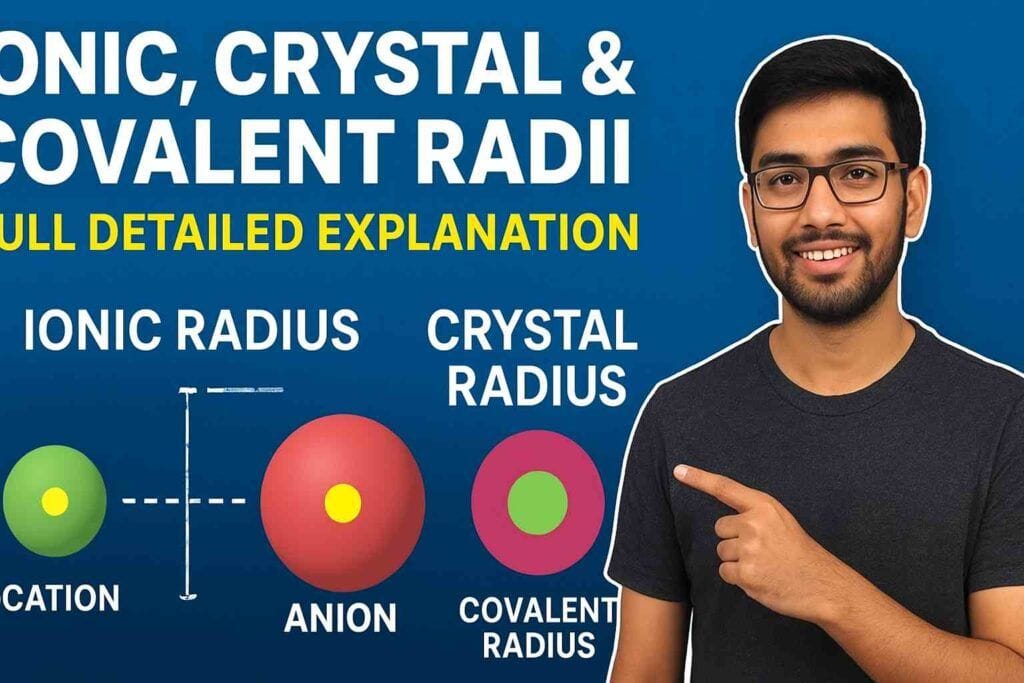
B.Sc.1 Year Major 1 Unit III Module 5
B.Sc. 1 Year Major 1 Unit III Module 5 में Ionic, Crystal और Covalent Radii का पूर्ण विस्तृत अध्ययन किया गया है। इसमें cation–anion size, isoelectronic series, tetrahedral-octahedral radii और crystal structure से जुड़े सभी महत्वपूर्ण concepts सरल भाषा में समझाए गए हैं।
Article ko Audio form Me sunne ke liye niche audio pe click kare
Module 5: Ionic, Crystal & Covalent Radii (Full Detailed Explanation)
इस module में हम atoms के ionic रूप, crystal structure, और covalent bonding में radius कैसे बदलता है—इसका गहरा relation समझेंगे।
1. Ionic Radius (Cations vs Anions)
👉 Ionic radius = charged atom (ion) का size
(A) Cations (Positive ions)
- Electron loss करते हैं
- Proton संख्या same रहती है → attraction बढ़ जाता है
- Electron cloud nucleus की ओर खिंच जाता है
→ Cation radius छोटा होता है (parent atom से भी छोटा)
Example:
Na (186 pm) → Na⁺ (95 pm)
Reason:
- Electrons कम हो गए
- Shielding कम
- Effective nuclear charge per electron बढ़ गया
(B) Anions (Negative ions)
- Electron gain करते हैं
- Added electrons आपस में repulsion बढ़ाते हैं
- Effective nuclear charge divide हो जाता है
→ Anion radius बड़ा होता है (parent atom से भी बड़ा)
Example:
Cl (99 pm) → Cl⁻ (181 pm)
Size order (General Rule)
Cation < Atom < Anion
2. Crystal Radius (Pauling’s Method)
Crystals में ions एक perfect geometrical arrangement में रहते हैं।
इसलिए दो ions की contact distance को measure करके उनकी individual radii निकालने का तरीका दिया गया था — Linus Pauling ने।
Pauling’s Concept:
- If two ions A⁺ and B⁻ crystal में touch कर रहे हैं
- Then: d = r₊ + r₋
जहाँ
d = distance between nuclei
r₊ = radius of cation
r₋ = radius of anion
Example:
NaCl crystal में distance = 281 pm
Given r(Na⁺) = 95 pm
तो r(Cl⁻) = 281 – 95 = 186 pm
👉 Crystal radius strictly crystal geometry पर depend करता है।
3. Covalent Radius in Different Geometries
Covalent radius हमेशा bonding geometry से बदलता है।
(A) Tetrahedral Covalent Radius
- Atom चार single covalent bonds बनाता है
- Typical shape: sp³ hybridized (उदाहरण: CH₄, SiCl₄)
- Bonds directional होते हैं → radius थोड़ा कम होता है
(B) Octahedral Covalent Radius
- Atom छह covalent bonds बनाता है
- Geometry symmetrical → distance uniformly distributed
- Radius थोड़ा बड़ा माना जाता है
👉 Formula used in crystallography varies but conceptually:
Tetrahedral bond length < Octahedral bond length
→ Tetrahedral radius < Octahedral radius
4. Factors Affecting Ionic Size
(1) Nuclear charge (Z)
- Z ↑ → electrons मजबूत attract होते हैं → size ↓
(2) Number of electrons
- Electrons बढ़ें → repulsion ↑ → ionic size ↑
(3) Oxidation state
High + oxidation state ⇒ radius बहुत कम
Example: Fe³⁺ (64 pm) < Fe²⁺ (78 pm)
(4) Coordination number
- Higher coordination number (CN): size थोड़ा बड़ा माना जाता है
- Reason: Ion को कई directions में repulsion झेलना पड़ता है
Example:
CN = 4 → small radius
CN = 6 → larger
CN = 8 → even larger
(5) Crystal environment
- Different crystal structures (rock-salt, fluorite, wurtzite)
- Same ion के radii में small variations आते हैं
5. Isoelectronic Series
Isoelectronic species = जिनमें electrons की संख्या same होती है, पर nuclear charge अलग।
Rule:
Z बढ़ता है → size घटता है
Example:
O²⁻ (Z=8) > F⁻ (Z=9) > Ne (Z=10) > Na⁺ (Z=11) > Mg²⁺ (Z=12) > Al³⁺ (Z=13)
Reason:
- Electrons बराबर पर protons बदलते हैं
- Proton ↑ → attraction ↑ → radius ↓
👉 यह concept ionic radii का सबसे important numerical concept है।
Learning Outcome (High-Quality Summary)
इस module को पढ़कर छात्र—
✔ Cations छोटे और anions बड़े क्यों होते हैं—atomic level पर समझेंगे।
✔ Pauling के crystal radius concept से ionic bonding और crystal geometry का link समझेंगे।
✔ Tetrahedral और octahedral covalent radii का structural difference समझ पाएँगे।
✔ Ionic radius किन factors से प्रभावित होती है—इसका full conceptual clarity पाएँगे।
✔ Isoelectronic series में radius क्यों systematically बदलता है—numerical sense develop करेंगे।
images compress karne ke liye yaha click kare |
B.Sc. 1 Year Major 1 Unit III Module 4 Ko dekhne ke liye yaha click kare
- 1. Ionic radius क्या होता है?
Ionic radius किसी ion के आकार को दर्शाता है। - 2. Cation का size छोटा क्यों होता है?
Electron loss और अधिक effective nuclear charge के कारण। - 3. Anion बड़ा क्यों होता है?
Electron gain से repulsion बढ़ता है और size बढ़ जाता है। - 4. Crystal radius क्या होता है?
Crystal lattice में ions की effective दूरी को Crystal radius कहते हैं। - 5. Covalent radius कैसे मापा जाता है?
दो atoms के बीच bond length का आधा। - 6. Crystal radius और ionic radius में क्या अंतर है?
Ionic radius ion के लिए है और crystal radius lattice structure के लिए। - 7. Isoelectronic ions में size किस पर depend करता है?
Nuclear charge पर — Z जितना अधिक, size उतना छोटा। - 8. Cation का order क्या होता है?
More positive charge → smaller size। - 9. Covalent radius metals और non-metals में कैसे बदलता है?
Metals में metallic radius और non-metals में covalent radius देखा जाता है। - 10. Ionic radius कैसे determine किया जाता है?
X-ray diffraction और spectroscopy से। - 11. Crystal radius का उपयोग कहाँ होता है?
Ionic solids, structure prediction और bonding nature को समझने में। - 12. Covalent radius किसमें बड़ा होता है — single या multiple bond?
Single bond में radius बड़ा होता है। - 13. Increasing anion size का trend क्या है?
More negative charge → larger radius। - 14. Period में atomic radius और ionic radius का trend एक जैसा है?
नहीं, ionic radius charge पर depend करता है। - 15. कौन सा factor तीनों radii को affect करता है?
Nuclear charge, electron count और screening effect।