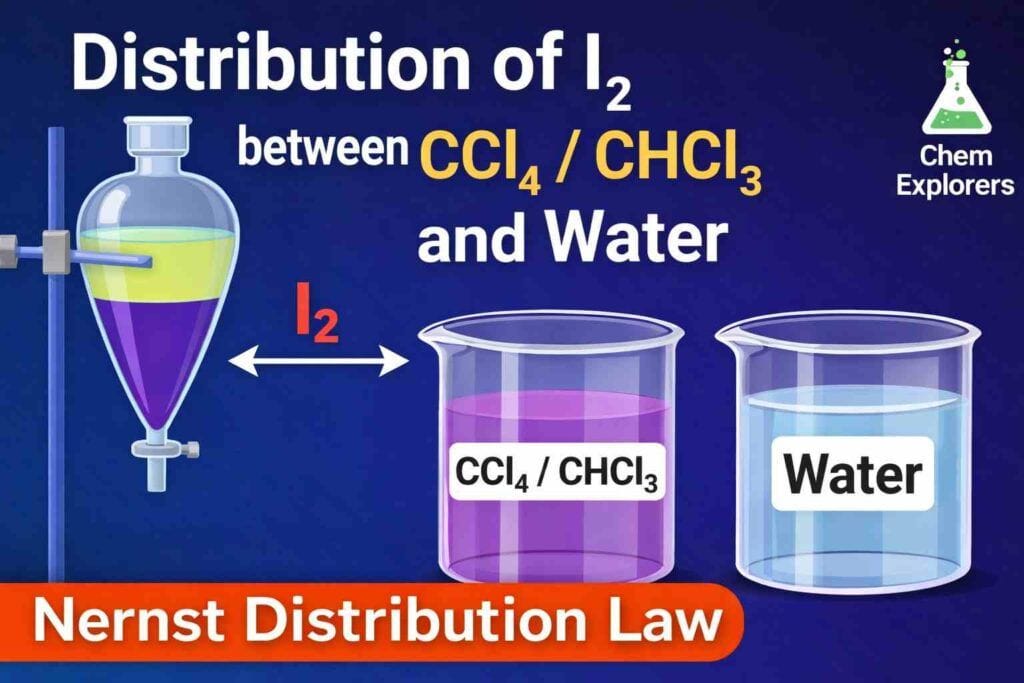
distribution law
Distribution of I₂ between CCl₄ / CHCl₃ and Water practical in Hindi with complete theory, aim, apparatus, procedure, observation table, calculations, result, precautions and viva questions. Verification of Nernst Distribution Law for B.Sc and M.Sc chemistry students explained step by step.
Distribution of I₂ between CCl₄ / CHCl₃ and Water (Distribution Law)
उद्देश्य (Aim)
Room temperature पर **Carbon tetrachloride (CCl₄) / Chloroform (CHCl₃) और Water के बीच Iodine (I₂) के वितरण का अध्ययन करना तथा Nernst Distribution Law का सत्यापन करना।
सिद्धांत (Theory)
जब कोई विलेय (solute) दो ऐसे द्रवों में वितरित होता है जो एक-दूसरे में अघुलनशील (immiscible) होते हैं, तब वह दोनों द्रवों के बीच एक निश्चित अनुपात में वितरित हो जाता है। इस सिद्धांत को Nernst Distribution Law कहते हैं।
Nernst Distribution Law
निश्चित तापमान पर यदि कोई विलेय दो अघुलनशील विलायकों के बीच वितरित होता है तो दोनों विलायकों में उसकी सांद्रताओं का अनुपात स्थिर रहता है।
गणितीय रूप में:K=C2C1
जहाँ
- C1 = पहले विलायक (CCl₄ / CHCl₃) में विलेय की सांद्रता
- C2 = दूसरे विलायक (Water) में विलेय की सांद्रता
- K = Distribution coefficient
Iodine का व्यवहार
Iodine (I₂) पानी में बहुत कम घुलता है जबकि CCl₄ या CHCl₃ जैसे organic solvents में अधिक घुलता है। इसलिए iodine इन दोनों विलायकों के बीच वितरित हो जाता है।
जब iodine को इन दोनों विलायकों के साथ रखा जाता है और अच्छी तरह हिलाया जाता है तो equilibrium स्थापित हो जाता है। इस समय iodine दोनों परतों में एक निश्चित अनुपात में उपस्थित रहता है।
Titration Principle
Water layer में उपस्थित iodine की मात्रा को sodium thiosulphate (Na₂S₂O₃) से titrate करके ज्ञात किया जाता है।
Reaction:I2+2Na2S2O3→2NaI+Na2S4O6
Starch indicator iodine के साथ नीला रंग देता है जो titration के अंत में समाप्त हो जाता है।
आवश्यक उपकरण (Apparatus)
- Separating funnel
- Burette
- Pipette
- Conical flask
- Measuring cylinder
- Stopper bottle
आवश्यक रसायन (Chemicals)
- Iodine solution in CCl₄ / CHCl₃
- Distilled water
- Sodium thiosulphate solution (N/100)
- Starch indicator
प्रयोग की विधि (Procedure)
- Separating funnel में iodine solution (CCl₄ / CHCl₃) और समान मात्रा में distilled water डालें।
- Separating funnel को बंद करके लगभग 10–15 मिनट तक अच्छी तरह हिलाएँ।
- इसे कुछ समय स्थिर रखें ताकि दोनों परतें अलग हो जाएँ।
- नीचे की organic layer (CCl₄/CHCl₃) और ऊपर की aqueous layer (water) अलग हो जाएँगी।
- Water layer को carefully निकाल लें।
- Pipette से 10 ml water layer लें और conical flask में डालें।
- इसमें कुछ बूंदें starch indicator की डालें।
- इसे N/100 sodium thiosulphate solution से titrate करें।
- End point पर नीला रंग समाप्त हो जाएगा।
- इसी प्रकार experiment को तीन बार दोहराएँ।
प्रेक्षण (Observation)
Burette Solution
Sodium thiosulphate (Na₂S₂O₃)
Pipette Solution
Water layer containing iodine
Indicator
Starch
Titration Table
| Trial | Initial Reading (ml) | Final Reading (ml) | Volume Used (ml) |
|---|---|---|---|
| 1 | 0.0 | 8.2 | 8.2 |
| 2 | 0.0 | 8.0 | 8.0 |
| 3 | 0.0 | 8.1 | 8.1 |
Average burette reading = 8.1 ml
गणना (Calculations)
Step 1
Normality of Na₂S₂O₃ = N/100 = 0.01 N
Volume of Na₂S₂O₃ used = 8.1 ml
Volume of aqueous layer = 10 ml
Step 2
Using formula:
Concentration of iodine in water layer = 0.0081 N
Step 3
मान लें organic layer में iodine की concentration = 0.065 N
अब Distribution coefficient निकालते हैं।
परिणाम (Result)
Room temperature पर iodine का distribution coefficient (K) between CCl₄ / CHCl₃ और water लगभग 8.0 पाया गया।
यह परिणाम Nernst Distribution Law के अनुरूप है।
सावधानियाँ (Precautions)
- Separating funnel को अच्छी तरह बंद करके हिलाएँ।
- दोनों परतों को पूरी तरह अलग होने दें।
- Burette reading सही लें।
- Starch indicator अंत में डालें।
- Temperature स्थिर रखें।
त्रुटि के स्रोत (Sources of Error)
- Iodine का आंशिक वाष्पीकरण
- Layers का सही separation न होना
- Indicator अधिक मात्रा में डालना
- Titration में reading error
वाइवा प्रश्न (Viva Questions)
1. Distribution law किसने दिया था?
Nernst
2. Distribution coefficient क्या होता है?
दो अघुलनशील विलायकों में विलेय की सांद्रताओं का अनुपात।
3. Iodine water में कम घुलता है क्यों?
क्योंकि iodine non-polar है जबकि water polar solvent है।
4. Starch indicator क्यों उपयोग किया जाता है?
यह iodine के साथ नीला complex बनाता है।
5. Distribution law किन स्थितियों में लागू होता है?
जब temperature constant हो और solute दोनों solvents में समान molecular state में हो।