B.Sc.1 Year Major 1 Unit III Module 3
B.Sc. 1 Year Major 1 Unit III Module 3 explains Slater’s Rules in a clear and detailed way. Learn shielding effect, screening constants, and Zₑff calculation with step-by-step examples. Perfect for exams and easy conceptual understanding.
iS Article Ko audio form me sunne ke liye niche audio pe click kare
Module 3: Slater’s Rules (Full Detailed Explanation)
Slater’s Rules क्या हैं?
Slater’s Rules एक तरीका है जिससे हम किसी atom या ion में किसी electron का Effective Nuclear Charge (Zeff) निकालते हैं।
इसमें electrons को अलग-अलग groups में बाँटा जाता है, और हर group कुछ shielding (S) प्रदान करता है।
Slater’s Rules — Step-by-Step
✔ Step 1: Electronic configuration लिखो
Electron configuration को सही order में लिखना ज़रूरी है।
✔ Step 2: Electrons को Slater Groups में बांटो
Slater ने electrons को इस तरह groups में रखा है:
(A) For s- & p-block electrons (most common)
Grouping rule:
(1s)
(2s, 2p)
(3s, 3p)
(4s, 4p)
(5s, 5p) …
यानि:
- एक ही shell के s और p electrons एक ही group में होते हैं।
(B) For d- and f-electrons
d और f की grouping अलग होती है:
(3d)
(4d)
(5d)
d-electrons सिर्फ अपने से पहले वाले d-electrons द्वारा shield होते हैं।
Shielding Contribution (S) कैसे निकाला जाता है?
Case 1: s- और p-electrons
यदि जिस electron का Zeff निकालना है वो किसी n shell में है:
(i) SAME group electrons (same n):
- हर electron S = 0.35
- लेकिन 1s के लिए 0.30
(ii) (n–1) shell electrons:
- हर electron S = 0.85
(iii) (n–2) या lower shells:
- हर electron S = 1.00
Case 2: d- और f-electrons
- Same group electrons → S = 0.35
- All electrons in shells lower than d or f → S = 1.00
- Outer electrons से कोई shielding नहीं मिलती
अब Numerical Questions (सबसे Important)
Example 1: Zeff of 2p electron in Oxygen (Z = 8)
Electronic configuration = 1s² 2s² 2p⁴
हम 2p electron का Zeff निकालेंगे।
(i) SAME group: 2s + 2p
2s² + 2p³ (other electrons) = कुल 4 electrons
Contribution:
4 × 0.35 = 1.40
(ii) (n–1) shell: 1s
Electrons = 2
Contribution:
2 × 1.00 = 2.00
Total Shielding:
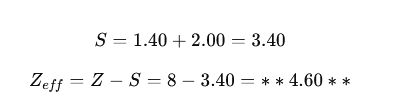
👉 2p electron पर effective pull = 4.60 units
Example 2: Zeff of 3p electron in Chlorine (Z = 17)
Electronic configuration: 1s² 2s² 2p⁶ 3s² 3p⁵
(i) Same group → 3s² + 3p⁴ = 6 electrons
6 × 0.35 = 2.10
(ii) (n–1) = n=3 → (2s² 2p⁶ = 8 electrons)
8 × 0.85 = 6.80
(iii) Lower = 1s² = 2 electrons
2 × 1 = 2.00
Total S = 2.10 + 6.80 + 2.00 = 10.90

Example 3 (d-block): Zeff of 3d electron in Fe (Z = 26)
Electronic configuration = [Ar] 3d⁶ 4s²
We calculate for 3d electron.
(i) Same group → other d-electrons = 5
5 × 0.35 = 1.75
(ii) Electrons below 3d:
1s² 2s² 2p⁶ 3s² 3p⁶ 4s⁰ = कुल 18
18 × 1.00 = 18
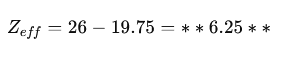
Total S = 1.75 + 18 = 19.75
Zeff Variation Across Periodic Table
✔ Across a period (→)
- Nuclear charge बढ़ता है
- Shielding बहुत कम बढ़ता है
👉 इसलिए

उदाहरण:
Li < Be < B < C < N < O < F
Zeff लगातार बढ़ता है
✔ Down a group (↓)
- Shell number बढ़ता है → shielding बहुत बढ़ती है
- Nuclear charge भी बढ़ता है, पर effect कम पहुँचता है
👉 इसलिए
Zeff थोड़ा-सा बढ़ता हैZ_{eff} \text{ थोड़ा-सा बढ़ता है}Zeff थोड़ा-सा बढ़ता है
लेकिन radius बहुत बढ़ जाता है।
Slater’s Rules क्यों Important हैं?
आप इससे predict कर सकते हैं:
✔ Atomic radius का variation
✔ Ionic size
✔ Ionization energy trends
✔ Electronegativity variation
✔ Reactivity trends
✔ d-block contraction
✔ Lanthanide contraction
✔ Transition metal properties
✔ Stability of orbitals
✔ Effective nuclear attraction
Learning Outcomes
इस module के बाद छात्र:
✔ Slater’s Rules step-by-step लिख पाएगा
✔ s, p, d, f electrons की shielding समझ पाएगा
✔ प्रत्येक type के numericals आसानी से कर लेगा
✔ Zeff trends को predict कर पाएगा
✔ Periodic properties की scientific वजह समझ पाएगा
✅ Slater’s Rules – 15 Important FAQs
1. Slater’s Rules क्या हैं?
Slater’s Rules ऐसे नियम हैं जिनसे किसी इलेक्ट्रॉन का effective nuclear charge (Zₑff) निकाला जाता है।
2. Effective Nuclear Charge (Zₑff) क्या होता है?
Nucleus द्वारा किसी electron पर लगने वाला वास्तविक आकर्षण बल, shielding हटाने के बाद।
3. Zₑff का formula क्या है?
Zₑff = Z – σ (जहाँ Z = atomic number, σ = screening constant)
4. Shielding effect क्या होता है?
Inner electrons द्वारा outer electrons पर nuclear attraction को कम करना shielding effect कहलाता है।
5. Screening constant (σ) कैसे निकाला जाता है?
Slater’s Rules में दिए गए group-wise values से σ calculate किया जाता है।
6. किन orbitals पर Slater’s Rules लागू होते हैं?
s, p, d और f सभी orbitals पर लागू होते हैं, लेकिन values अलग होती हैं।
7. s और p electrons के लिए shielding कैसे calculate होता है?
Slater’s table में दिए गए नियमों के अनुसार same group, n–1 shell और n–2 shell के electrons से shielding ली जाती है।
8. d और f orbitals के लिए shielding कैसे calculate होती है?
d और f electrons के लिए same group के electrons से भी stronger shielding मिलती है।
9. कौन सा electron सबसे अच्छा shield करता है?
Inner-shell (core) electrons सबसे अच्छी shielding करते हैं।
10. Slater’s Rules कहाँ उपयोग किए जाते हैं?
Atomic structure, Zeff calculation, periodic trends और chemical behavior समझने में।
11. क्या Slater’s Rules accurate होते हैं?
हाँ, लेकिन approximate method है; purely theoretical नहीं है।
12. Zₑff बढ़ने से क्या होता है?
Atoms छोटे होते हैं, ionization energy बढ़ती है, electrons nucleus के अधिक पास खिंचते हैं।
13. Same period में Zₑff क्यों बढ़ता है?
Nuclear charge बढ़ता है लेकिन shielding बहुत कम बढ़ती है।
14. Transition metals में Zₑff क्यों अलग होता है?
क्योंकि d-electrons की shielding कमजोर होती है, जिससे Zₑff comparatively ज्यादा रहता है।
15. Exam में Slater’s Rules कैसे पूछे जाते हैं?
Direct numerical calculation, shielding calculation, Zeff निकालना, या periodic trends से related questions आते हैं।